Artificial Intelligence and the Humanities · 2026
Reading Stance Parameterized: LLM Agents as Proxies for the Literary Encounter
One node within a larger project, see General Map of the Literary Encounter for the fuller architecture this study is one small, focused zone of.
Research Question and Motivation
Existing computational approaches to literature operate almost exclusively on the text-as-inscription side of the literary encounter. Stylometrics captures surface features of style, embedding models encode semantic content as vectors, both treat the text as a stable object with extractable properties, leaving the reader side of the encounter largely unaddressed. Reader response scholarship has argued for decades that meaning is not stored in the text alone, it is produced in the encounter between a reader and a text, shaped by the reader's orientation, purpose, and interpretive stance.
This project takes that claim seriously and builds an empirical instrument around it. Rather than asking what a text contains, it asks: do differently oriented readers produce systematically different readings of the same text, and can those differences be detected and measured computationally using large language models as proxies for reading stances? This is a deliberately narrow proof of concept, one zone of a much larger map of what a literary encounter is.
Method
Three reading stance parameters were operationalized through system prompts to claude-sonnet-4-6, each a contrastive pair drawn from reader response theory: reading purpose (efferent or aesthetic), reading orientation (identification or estrangement), and narrative trust (surface or suspicious). A seventh, unprompted control agent served as a baseline. All seven agents read every passage of every text.
These agents are not human readers. They have no bodies, biographies, or emotional lives, what they have are output probability distributions that can be steered by linguistic context. When instructed to read suspiciously, an agent generates responses with that orientation, not a genuine instance of it. This limitation is not incidental, it maps precisely onto the boundary between what can be operationalized and what the literary encounter exceeds.
Corpus and Pipeline
Fifteen texts were selected across three categories: five canonical science fiction texts with sustained critical recognition (Asimov, Clarke, Ellison, Tiptree, Wells), five pulp science fiction texts from genre magazines without canonical recognition, and five LLM-generated texts produced from a neutral prompt, serving as a control condition. Each text was divided into roughly 500-word passages and fed simultaneously to all seven agents, each scoring six dimensions on a 1 to 5 scale: Ideological Salience, Affective Intensity, Narrative Expectation, Formal Opacity, Interpretive Certainty, and Literary Distinctiveness.
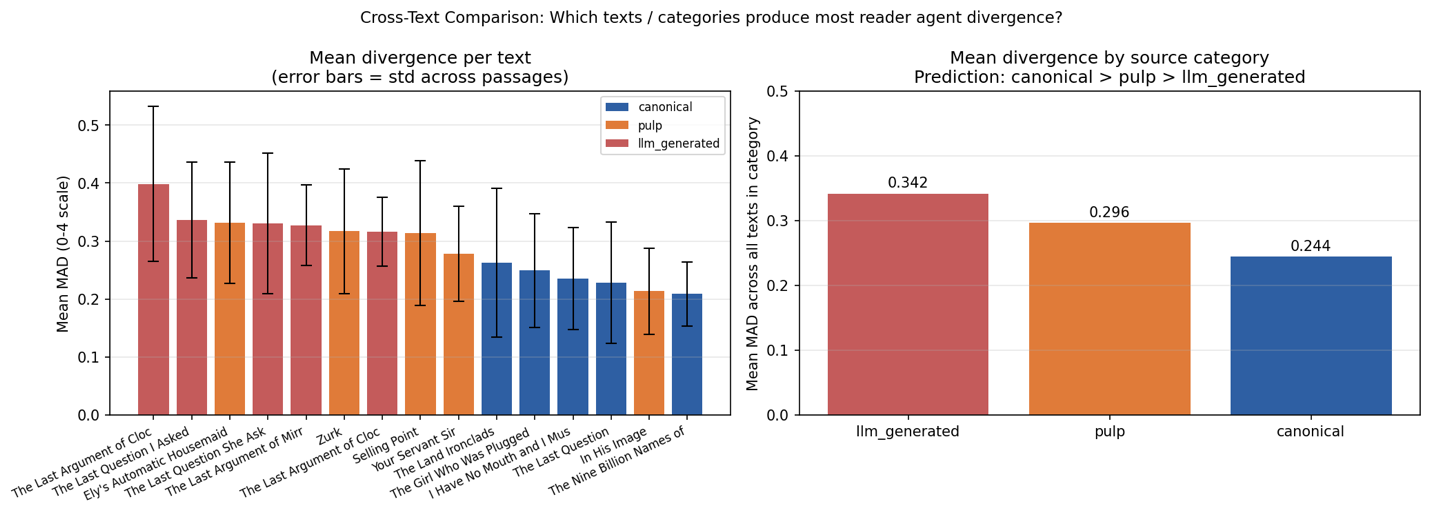
Agent divergence per passage was calculated using Mean Absolute Difference across all agent pairs and all six dimensions, with per-parameter divergence computed separately to identify which reading stance parameter drives disagreement most at each passage.
Findings
Narrative trust, surface versus suspicious reading, produces more between-agent divergence than either reading purpose or reading orientation, consistently across all three text categories. Formal opacity, by contrast, cleanly separates the text categories themselves rather than the reading stances: canonical texts score highest, then LLM-generated, then pulp, and every agent agrees on this ranking regardless of parameterization, suggesting formal opacity is closer to a stable property of the text than something reader-inflected. Literary distinctiveness separates the categories in the predicted direction, canonical above LLM-generated above pulp, while interpretive certainty shows almost no variance across any agent or stance.
The most surprising result reverses the original prediction entirely. Overall divergence ranks LLM-generated texts above pulp above canonical, the opposite of the expectation that canonical texts, with more genuine ambiguity, would afford more varied readings. LLM-generated texts may be ideologically under-determined, lacking a strong authorial voice, which leaves more room for reading stances to diverge, while canonical texts, precisely because of their formal control, may constrain the range of plausible readings. This points to a deeper validity problem for computational literary measurement: a text that is rich and genuinely ambiguous, and a text that is simply empty and under-determined, can produce the same high divergence score for entirely different reasons.
Conclusion and Future Directions
This project is not a human reader in any sense, and it is far from fully modeling the reader-text encounter in literature. What it demonstrates is narrower and more useful: linguistic parameterization of an LLM's output distribution via reading stance instructions produces systematically patterned divergence that is theoretically coherent with reader response theory. As LLMs become more embedded in how texts are read, summarized, and evaluated, understanding how they operate as computational entities that engage with literary texts is worth exploring in its own right, what they reveal about text, pattern, and structure may tell us something about human creation and literature that exceeds the original hypotheses.
This project imagines itself as one node within a federated computational approach to literature, one that would eventually deploy different methods across different zones of the literary encounter: stylometric analysis for inscription-level properties, embedding-based clustering for semantic structure, surprise-rhythm curves for the temporal reading experience, parameterized reader agents for modes of reading, and intertextuality networks for transtextual relations. Each method reaches a different zone, and their combined output would produce a multi-dimensional account of what happens when a reader meets a text, without ever closing the gap between what such a system measures and what the literary encounter actually is.
Full Write-Up
The complete write-up includes the full theoretical framing, all five findings in detail, and the discussion of validity problems that arise when using a closed-source LLM as a reading-stance instrument. Coursework.
↓ Download PDF