Conceptual Framework · 2026
General Map of the Literary Encounter
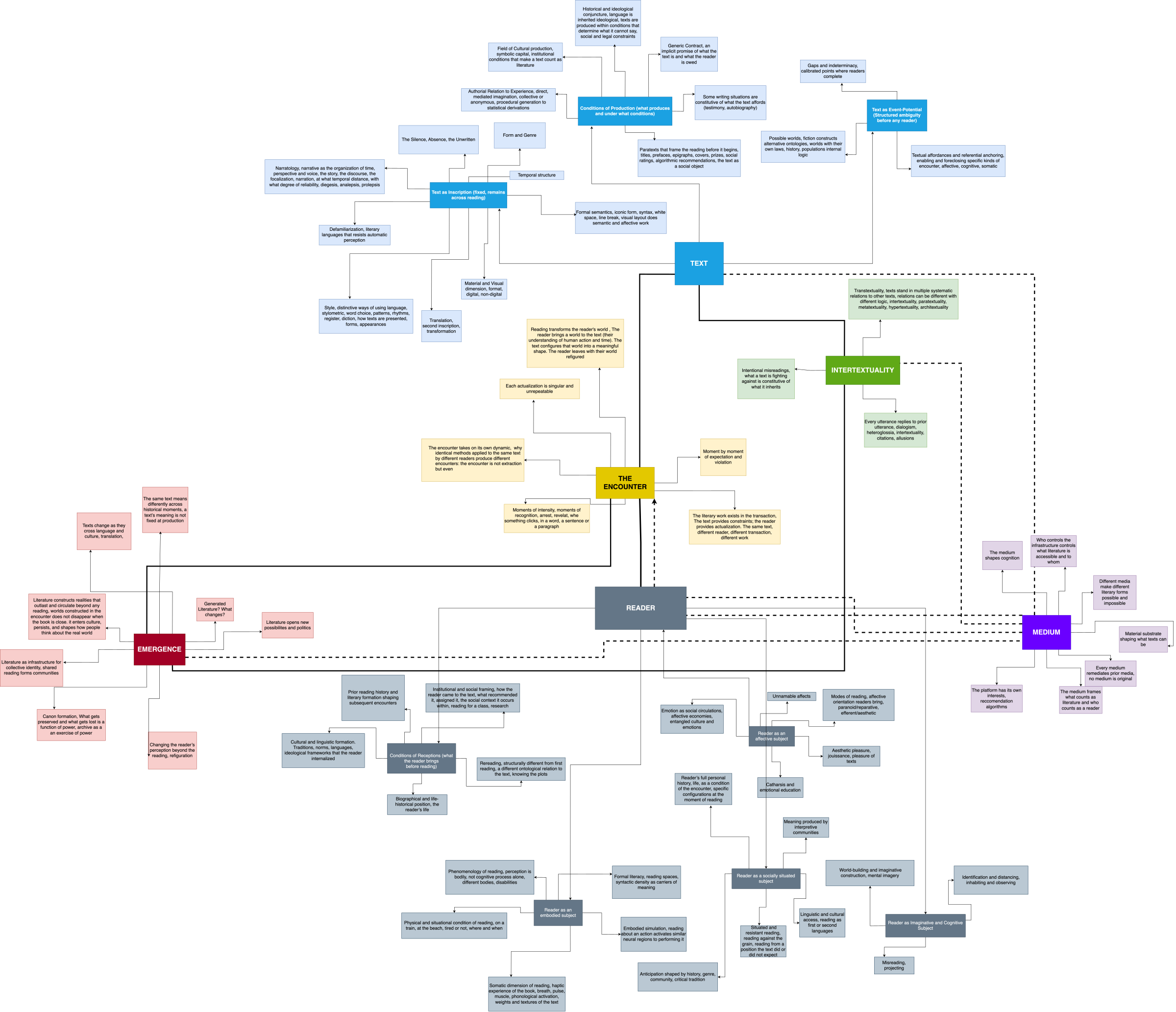
The scaffold behind Reading Stance Parameterized LLM Agents , which takes up one small, focused zone of the map below as a proof of concept.
Why a Map
Most current computational definitions of literature, in LLM studies, in digital humanities, in computer science, work with a narrow and often rigid sense of what a literary encounter is. Stylometrics captures surface features of style. Embedding models encode semantic content as vectors. Both treat the text as a stable, self-contained object, and both leave a large gap unaddressed: what a literary encounter actually is for a human reader, embodied, affective, historically and socially situated, is not the same as what it is for a non-human reader, a model with no body, no biography, and no stakes in the encounter beyond an output probability distribution.
This map is an attempt to chart that fuller architecture before choosing a method. Rather than starting from what is easy to computationally operationalize, it starts from the full set of conditions and factors that constitute a literary encounter, including the medium a text moves through, the circumstances of its production, and the social and institutional position of the reader, and only then asks which zones current methods can reach, and which they cannot.
The Components
Medium covers who controls the infrastructure a text is accessible through, the platform and its recommendation algorithms, and the material substrate shaping what a text can even be, print, screen, or otherwise.
Text splits into two conditions: text as inscription, the fixed, stylometrically stable object that remains across readings, and text as event-potential, the structured ambiguity a text holds before any reader arrives, its gaps, paratexts, and possible worlds.
Intertextuality holds the relations a text stands in to other texts, dialogic, heteroglossic, allusive, citational, relations that can differ in kind and logic from one another.
Reader is the largest zone: the conditions of reception a reader brings before reading, and the reader as an embodied subject, an affective subject, a temporal subject, an imaginative and cognitive subject, and a socially situated subject, each with its own further sub-conditions.
The Encounter is the moment itself, singular and unrepeatable, where the same method applied to the same text by different readers produces different encounters, expectation and violation playing out passage by passage.
Emergence covers what outlasts any single reading: canon formation, literature as infrastructure for collective identity, and the way a reader's perception of the world changes after the book is closed.
Toward a Federated Approach
No single computational method reaches every zone of this map, and the ambition here is not to find one that does. It's to deploy different methods across different zones, each calibrated to what it can and cannot access, stylometric analysis and embedding models for inscription-level properties of the text, surprise-rhythm curves for the temporal experience of reading, intertextuality networks for transtextual relations, parameterized reader agents, the approach taken in the companion project above, for modes of reading on the reader side of the encounter, and so on.
Each method would reach a different zone of the map, and their combined output would produce a multi-dimensional account of what happens when a human or nonhuman reader meets a text situated in different material and discursive practices and processes. By conceptually modeling this map, I offer a blueprint of an ever-expanding architecture for how computational proxies might engage with the literary encounter in a federated manner.