LLM Style Observatory
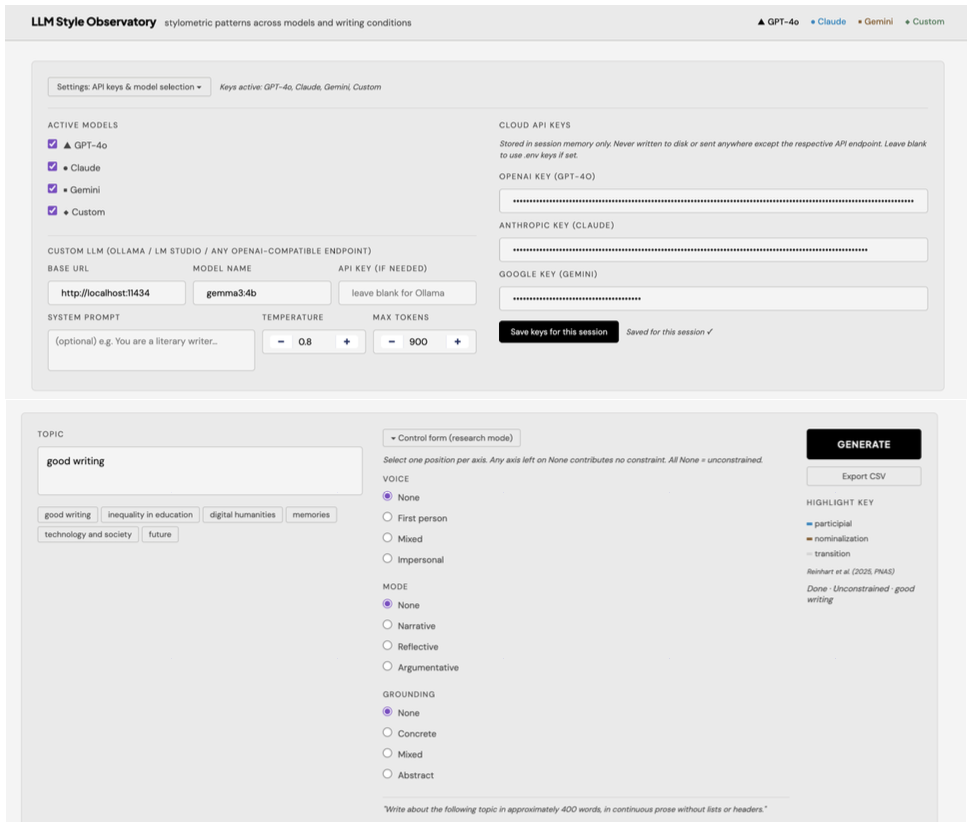
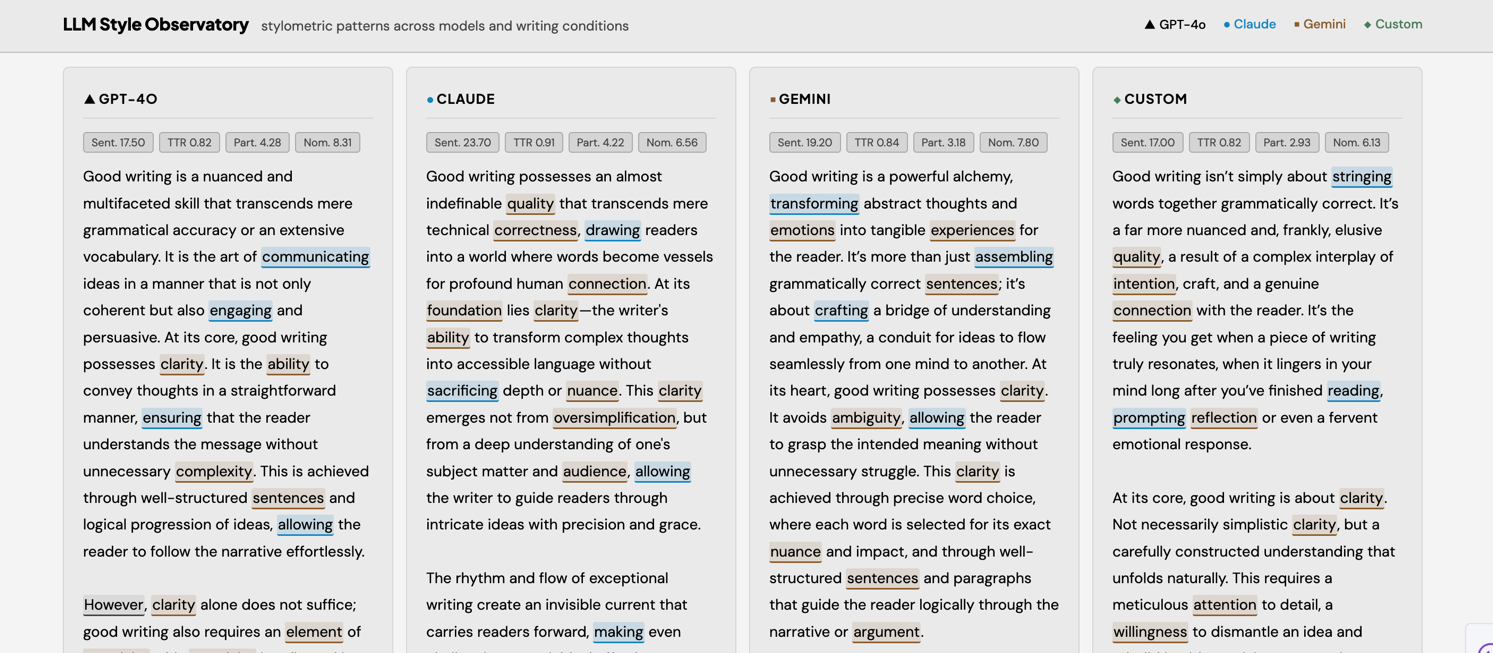
A stylometric reading instrument for comparing how GPT-4o, Claude, Gemini, and local models generate texts.
View on GitHub →Models Compared
- GPT-4o
- Claude Sonnet
- Gemini 2.5 Flash
- Custom (Ollama / LM Studio)
Features Tracked
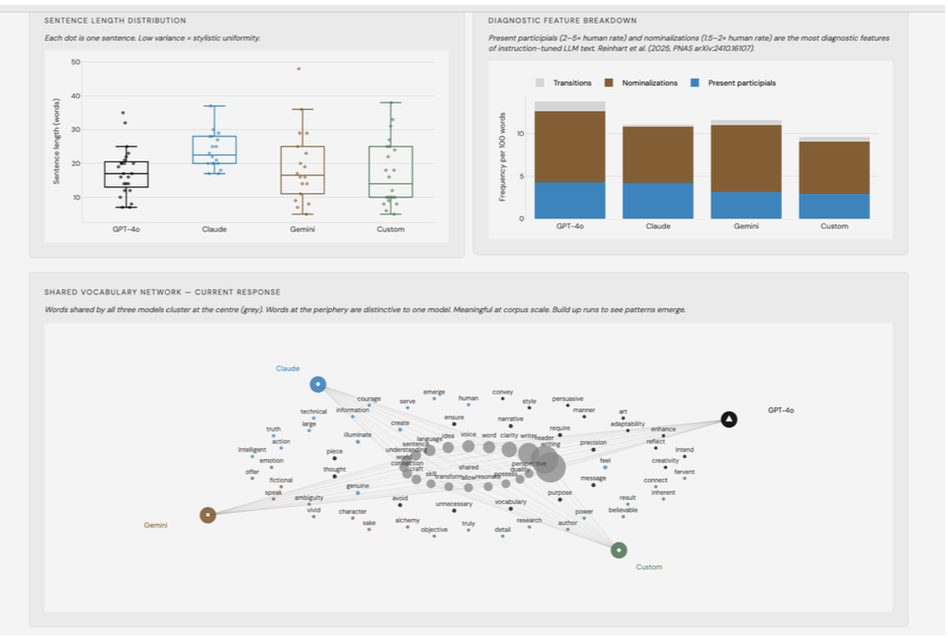
- Mean Sentence Length
- Sentence Length Variance
- Type-Token Ratio (MATTR)
- Present Participial Frequency
- Nominalization Frequency
- Discourse Transition Frequency
- Noun-to-Verb Ratio
- Passive Voice Frequency
- Average Word Length
Motivation
This project began with a specific frustration: the recognizable texture of AI-generated writing online, the recurring vocabulary, the uniform sentence rhythm, the tendency toward bullet points and transitional phrases. The question it poses is whether this texture is real and measurable, or whether it is merely a perceptual artifact of reading too much machine-generated text.
LLMs operate token by token on stochastic gradient descent, pure mathematics and probability, with no communicative intention behind the output. Yet the output has a recognizable quality that readers respond to as style. This dashboard is a tool for making that texture visible. It is a stylometric reading instrument, not a detection tool. The goal is not to flag AI-generated text, but to ask whether LLMs have stable, architecturally determined stylistic signatures that persist across topics and writing conditions.
Data
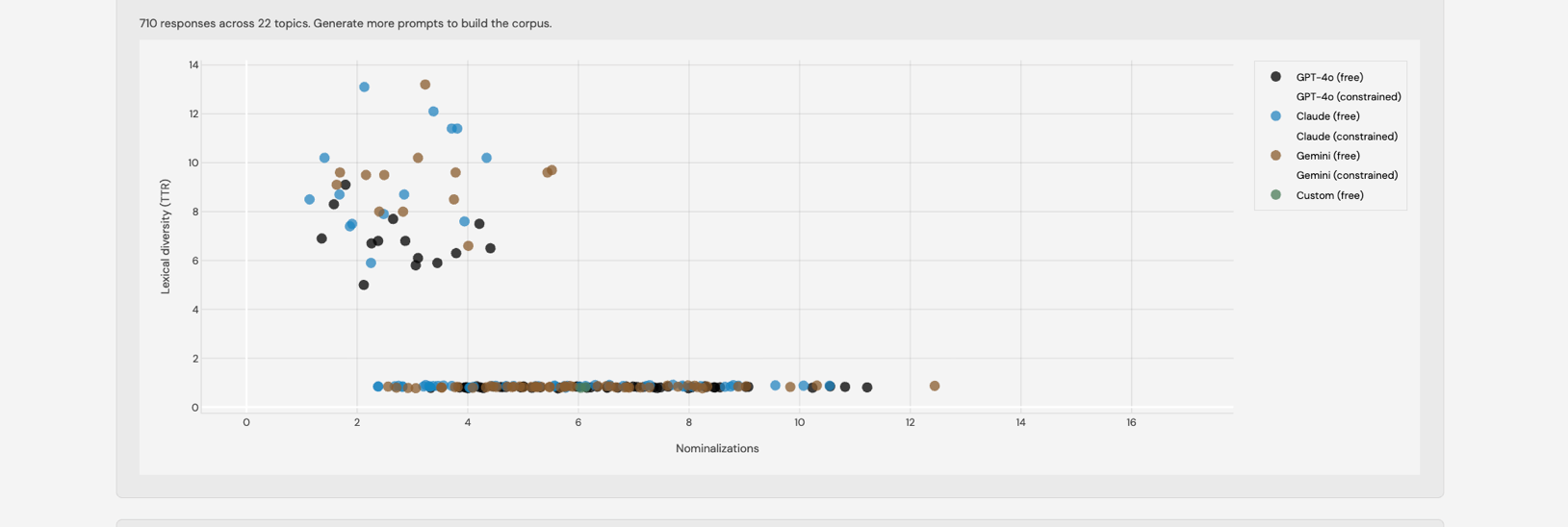
The dashboard generates text live from any topic a user supplies, comparing output across active models in real time. To seed the corpus scatter visualization, I pre-generated 683 prose responses from GPT-4o, Claude Sonnet, and Gemini 2.5 Flash across 15 single-word topics and four writing conditions. From each response, nine stylometric features are extracted using spaCy, with present participials and nominalizations weighted as the most diagnostically reliable markers of instruction-tuned LLM output.
Key Findings
The most consistent finding across the corpus is that GPT-4o has distinctively lower lexical diversity than Claude Sonnet or Gemini 2.5 Flash, a gap that holds across every topic and under both unconstrained and constrained writing conditions, suggesting it reflects something about GPT-4o's training or architecture rather than its response to topic content.
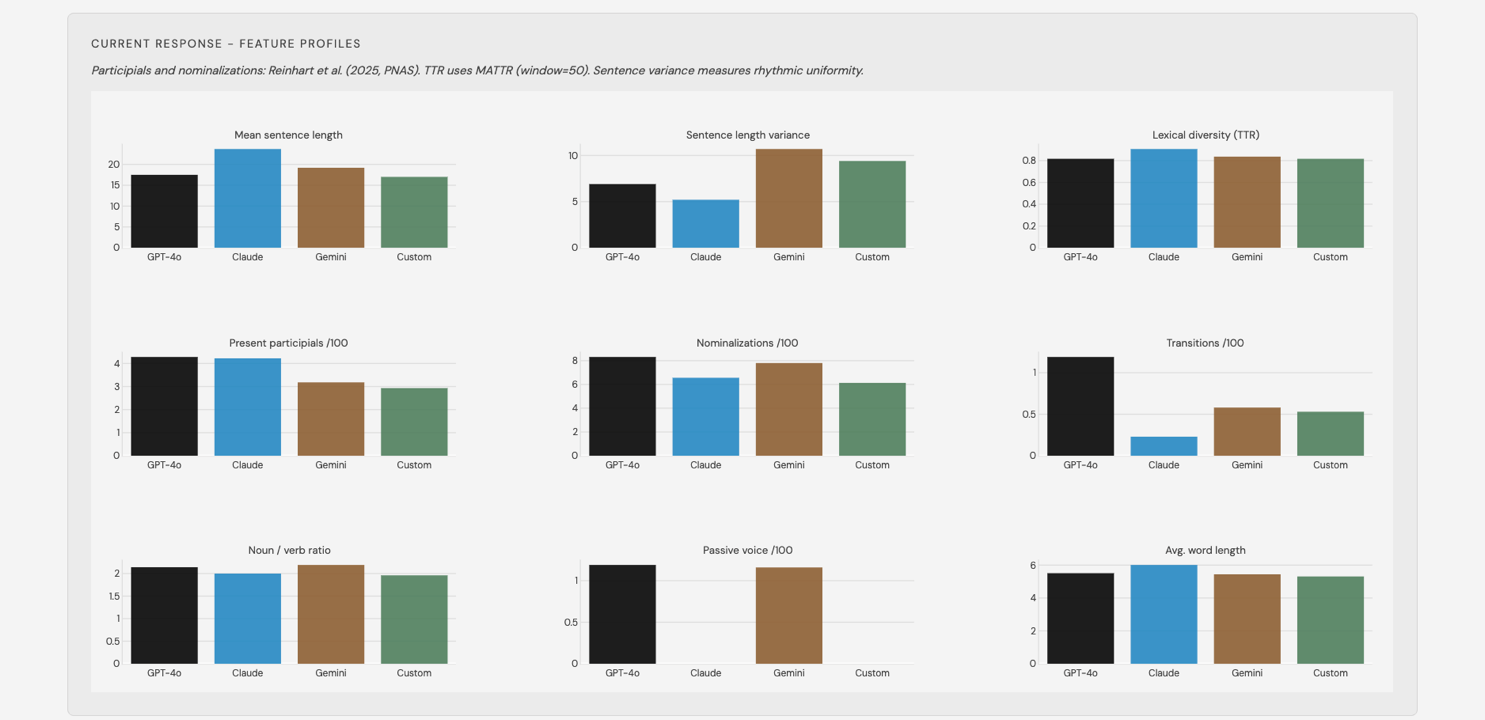
Nominalization rates, by contrast, are similar across all three models and elevated relative to a human baseline, consistent with a shared instruction-tuning effect rather than a model-specific signature. This dissociation, lexical diversity differentiates models while nominalization does not, supports the project's core claim: models carry both shared tendencies from instruction tuning and architecturally specific stylistic signatures. In close reading, Claude Sonnet also tends to produce more syntactically varied and metaphorically complex prose than GPT-4o or Gemini, whose outputs flatten more quickly toward a common register.